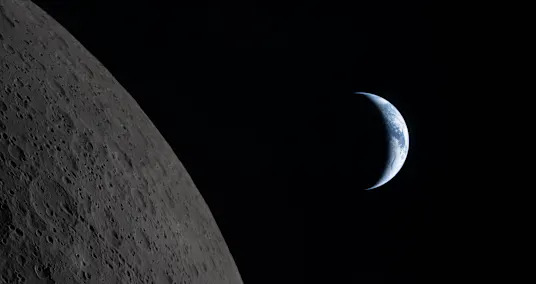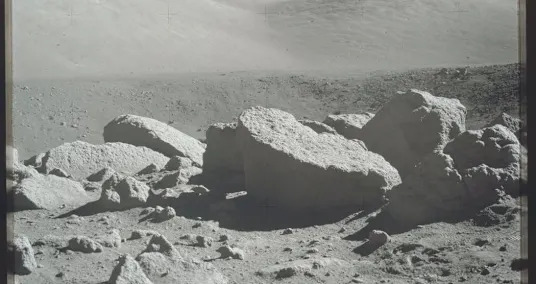
The Earth and the Moon may look very different today, but they formed under similar conditions in space. In fact, a dominant hypothesis says that the early Earth was hit by a Mars-sized object, and it was this giant impact that spun off material to form the Moon. But unlike Earth, the Moon lacks plate tectonics and an atmosphere capable of reshaping its surface and recycling elements such as oxygen over billions of years.
As a result, the Moon preserves a record of the geological conditions that helped shape it and can give scientists insight into the world we live in today. Rocks that were formed during early volcanic activity on the Moon offer a window into events that occurred nearly 4 billion years ago. By uncovering the conditions under which the Moon’s rocks formed, scientists move closer to understanding the origins of our own planet.
In a study published March 2026 in the journal Nature Communications, our team of physicists and geoscientists investigated ilmenite, a mineral composed of iron, titanium and oxygen, in a Moon rock crystallized from an ancient lunar magma. We used cutting-edge electron microscopy to probe the chemical signature of titanium in this ilmenite, finding that about 15% of the titanium carries less of an electrical charge than expected.

Implications of trivalent titanium
In ilmenite, an atom of titanium typically loses four electrons when bonding with oxygen, resulting in a positive charge of 4+, known as the atom’s oxidation number. From the sample we studied, a rock collected during the Apollo 17 mission, we found that some of the titanium in ilmenite actually has a charge of only 3+, referred to as trivalent titanium. Our measurement of trivalent titanium confirms what geologists had long suspected: that some titanium in lunar ilmenite exists in a lower charge state.
Trivalent titanium occurs only when the amount of oxygen available for chemical reactions is low. Thus, the abundance of trivalent titanium in ilmenite could tell us about the relative availability of oxygen in the Moon’s interior when the rock formed, around 3.8 billion years ago.
A link to the Moon’s early chemistry
Since it is the ilmenite, not the study, that contained trivalent titanium, I would recast the previous sentence as follows: “Our team has closely studied only one Moon rock so far, but from published studies we have identified more than 500 analyses of lunar ilmenite that could contain trivalent titanium. Studying these samples could reveal new details about how the Moon’s chemistry varies across different locations and time periods.
While our work highlights a link based on prior studies, the relationship between trivalent titanium in ilmenite and oxygen availability has not yet been quantified with targeted experimental data.
By conducting experiments that explore that link, ilmenite could reveal more details about the Moon’s interior. We also expect this relationship to apply to other planets and asteroids that don’t contain much chemically available oxygen, relative to Earth.
What’s next?
These methods can be used to study many Moon rocks collected during the Apollo missions over 50 years ago, as well as future samples from upcoming Artemis missions, or rocks collected from the far side of the Moon, returned in 2024 by China’s Chang’e-6 mission.
One of our team members plans to use their new experimental lab to explore how oxygen availability in magma affects the abundance of trivalent titanium in ilmenite. With experiments like this that build off our findings, we could potentially use ilmenite to reconstruct the history of ancient magmas from the Moon.
We believe future studies of lunar rocks using advanced scientific methods are essential for revealing the chemical conditions present on the ancient Moon. They could offer clues not only to its own history but also to the earliest chapters of Earth’s past – records that have since been erased from Earth.
This article is republished from The Conversation, a nonprofit, independent news organization bringing you facts and trustworthy analysis to help you make sense of our complex world. It was written by: Advik D. Vira, Georgia Institute of Technology and Emily First, Macalester College
Read more:
Advik D. Vira receives funding from the NASA Solar System Exploration Research Virtual Institute (SSERVI) under cooperative agreement number NNH22ZDA020C (CLEVER, Grant number: 80NSSC23M022).
Emily First receives funding from the Heising-Simons Foundation (grant # 2023-4485) and from a Macalester College faculty start-up fund.
NEUESTE BEITRÄGE
- 1
 Manual for Tracking down the Immaculate Magnificence of Focal Asia01.01.1
 - 2Most loved Road Food: Which One Prevails upon You?01.01.1
- 3Takeaways from AP’s report on potential impacts of Alaska’s proposed Ambler Access Road11.12.2025
- 4Like 'accelerating from stationary to supersonic flight': Europe's Hera probe boosts speed, stays on course for November asteroid rendezvous25.03.2026
- 5Only 30% of young people in Israel optimistic about future, Aluma survey reveals29.03.2026
- 6Astronomers spot white dwarf star creating a colorful shockwave12.01.2026
- 7Energy agency chief warns of 'black April' for oil supplies07.04.2026
- 8Which Startup's Innovation Could Reform Medical care?01.01.1
- 9Dancing through the crackdown: The satirical song soundtracking post-Khamenei Iran04.04.2026
- 10Arctic sea ice just dropped to an alarming new low26.03.2026
- 11Which Film Has the Incomparable Melodic Score?01.01.1
- 12Figure out How to Utilize Your Web based Advertising Degree to Break into the Tech Business19.10.2023
- 13The 15 Most Rousing TED Chats on Self-awareness07.07.2023
- 14Arctic sea ice hits lowest winter level as heat records are shattered worldwide27.03.2026
- 15Ukraine confirms defence and energy ministers at second attempt14.01.2026













Ähnliche Artikel
- Artemis 2 captures historic 'Earthset' photo | Space photo of the day for April 7, 202607.04.2026
- Tesla Germany Registrations Quadruple to 9,252 Vehicles in Best March Ever07.04.2026
- What's going on with Katseye? The Manon Bannerman hiatus drama, explained.07.04.2026
- Two IDF officers, civilian face indictment in alleged Gaza aid-truck smuggling scheme07.04.2026
- West Palm Beach Shorecrest, renderings of downtown waterfront condo07.04.2026
- Artemis II astronauts make long-distance call to the space station as they head home from the moon07.04.2026
- Tuesday, April 7. Russia’s War On Ukraine: News And Information From Ukraine07.04.2026
- The Eastern Bongo, Kenya’s Rare Forest Antelope on the Brink07.04.2026
- U.K. blocks Kanye West from entering Britain to headline now canceled festival: What led to the ban07.04.2026
- Russia confirms 16 Cameroonian soldiers killed in Ukraine war07.04.2026
- First Phosphate advances battery-grade phosphate project as analysts highlight strategic Federal support07.04.2026
- After fleeing past Hezbollah fighting, some Israelis on northern border vow to stay07.04.2026
- 'Unreal' solar eclipse: Artemis 2 crew just saw one of the rarest sights in spaceflight history07.04.2026
- Chinese construction workers in Israel: 'I’d rather be bombed than live in poverty'07.04.2026
- Broken toilet, T-shirts on windows and collecting saliva: The weirdness of daily life aboard Orion07.04.2026
- Czech Republic caps fuel prices amid Iran war energy crisis07.04.2026
- NASA releases stunning new images captured by the Artemis II moon mission, including 'Earthset' and a solar eclipse from space07.04.2026
- Amid Iran war, 53 of Israel's future scientists showcase projects in Jerusalem contest07.04.2026
- Iranian-linked drone attack kills Kurdish couple in northern Iraq07.04.2026
- Thousands of small fish defy gravity to climb Congo waterfall07.04.2026